
FAST-Python
FAST-Python is a FAST meta-model used to represent AST of a Python modules. It comes with a meta-model, an importer, a visitor and tools to manipulate and explore models.
Importer
Section titled “Importer”Installation
Section titled “Installation”FAST-Python comes with an importer based on TreeSitter’s python parser. To install it, execute the following script:
Metacello new githubUser: 'moosetechnology' project: 'FAST-Python' commitish: 'main' path: 'src'; baseline: 'FASTPython'; loadYou can add it to xour baseline like this:
spec baseline: 'FASTPython' with: [ spec repository: 'github://moosetechnology/FAST-Python:main/src' ]You can replace “main” by the tag you are interested in.
Quick start
Section titled “Quick start”In order to parse a chain of character or a file you can do this:
FASTPythonImporter parse: 'if x > 0: if x < 10: 1 else: 2else: 3'Or
FASTPythonImporter parseFile: myFileFAST-Python ships with a set of tools to explore and analyse a model once it is imported. The importer builds a FASTPyModel made of FASTPy* entities representing the whole AST:

The analysis tools described below can be combined. A typical analysis runs some (or all) of them:
FAST utilities → Local resolution → CFG → SSA. Each tool explains what it does, how to use it and what you can do with the result.
FAST Python visitor
Section titled “FAST Python visitor”FAST-Python comes with a visitor to walk a model, either used in the form of a trait with FASTPyTVisitor or a class to subclass with FASTPythonVisitor.
In some usages of the visitor some visit methods need to be overridden to change the visit order. For example, a visitor might need to ensure that function parameters are visited before the statements of the function.
FAST utilities
Section titled “FAST utilities”Some properties and helpers are available on the freshly imported model, without needing any additional tooling. Examples:
FASTPyMethodDefinition>>isStaticto know if a method is staticFASTPyMethodDefinition>>isAbstractto know if a method is abstractFASTPyMethodDefinition>>selfNameto know the name of theselfparameter (nil for static methods)FASTPyEntity>>#internalAccessto know if a node is accessed internally, e.g. via an attribute access (x.y) or a subscript (x[3])
Local resolution
Section titled “Local resolution”The local resolver (FASTPythonLocalResolverVisitor) links each usage of a node to its declaration. This works for all named entities: variables, functions, methods, imports.
It can be run like this:
FASTPythonLocalResolverVisitor resolve: aModule "could be any behavioral entity of a FASTPython model."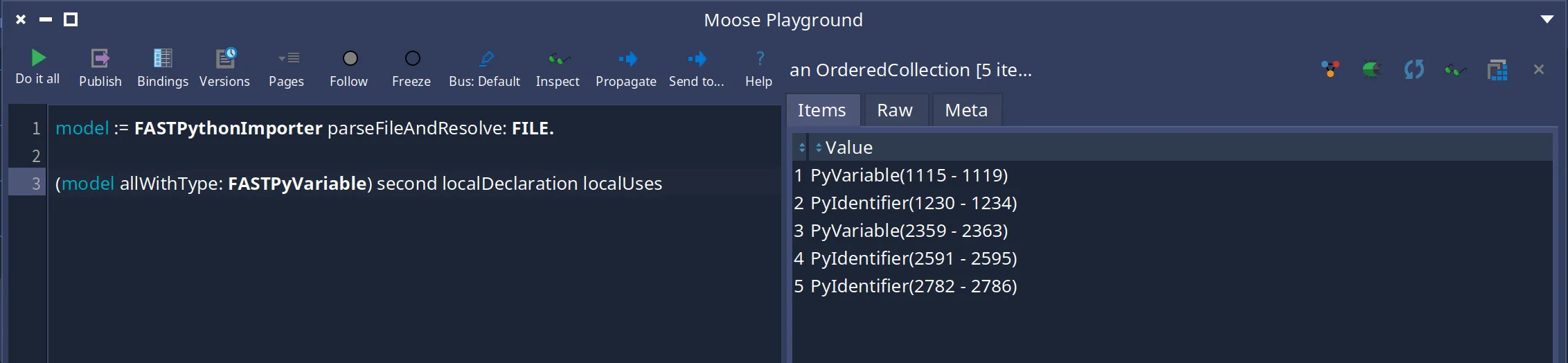
Once the resolution is done, you can ask:
FASTPyEntity>>#localDeclarationto get the declaration (the first definition) of an entity, or aFASTNonLocalDeclarationif it is not declared in the file- the declaration’s
#localUsesto get all the usages of the entity in the model FASTPyEntity>>#isResolvedVariableto know if a node resolves to a local variable declarationFASTPyEntity>>#allAccesses,#allReadAccesses,#allWriteAccessesto navigate the accesses to a variable- on the model,
FASTPyModel>>#allResolvedVariablesto get every entity resolving to a variable declaration, or#allResolvedVariablesByNameto group them by name
Control Flow Graph (CFG)
Section titled “Control Flow Graph (CFG)”The CFG (FASTPythonCFGVisitor) builds a control flow graph of a behavioral entity. It is a transparent prerequisite to SSA.
It can be used like this:
FASTPythonCFGVisitor buildCFGOf: aModel allFunctionDefinitions first.
"or"
aModel allFunctionDefinitions first cfg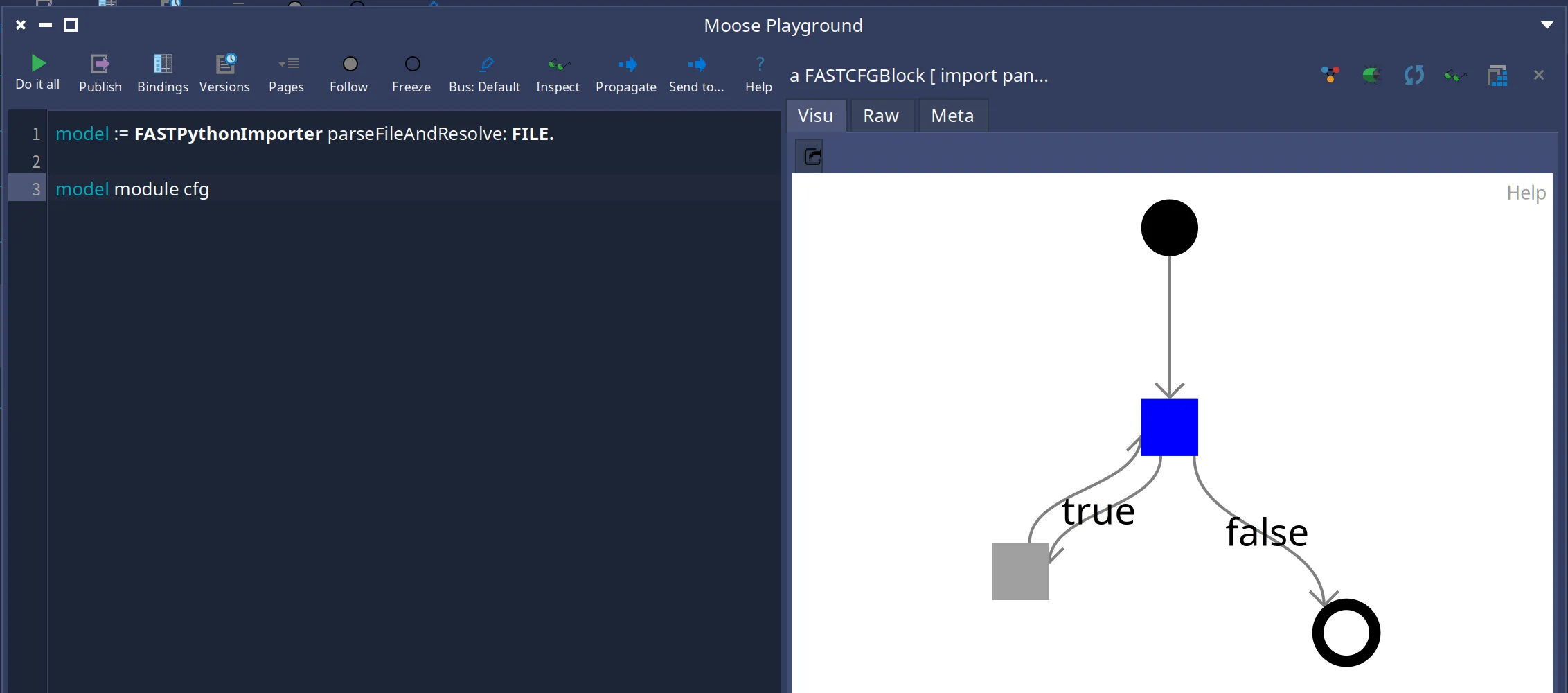
It can take one of five different entities to build a CFG:
- a
FASTPyModule - a
FASTPyFunctionDefinition - a
FASTPyMethodDefinition - a
FASTPyLambda - a
FASTPyClassDefinition
It is also possible to build a “full” CFG via FASTPythonCFGVisitor class>>#fullCfg, returning a dictionary with the CFG of the entity and the CFGs of all definitions found inside it.
For more information on building and visiting a CFG for FAST, see the dedicated page on the CFG.
Static Single Assignment (SSA)
Section titled “Static Single Assignment (SSA)”The SSA (FASTPythonSSAVisitor) scopes a variable to the assignments that can impact it (instead of all its assignments), which is used a lot for data-flow analysis. It renames each assignment with a fresh version, and introduces a phi version where a value can come from multiple assignments. It requires the local resolution to be done first.
It can be run like this:
FASTPythonSSAVisitor resolve: model module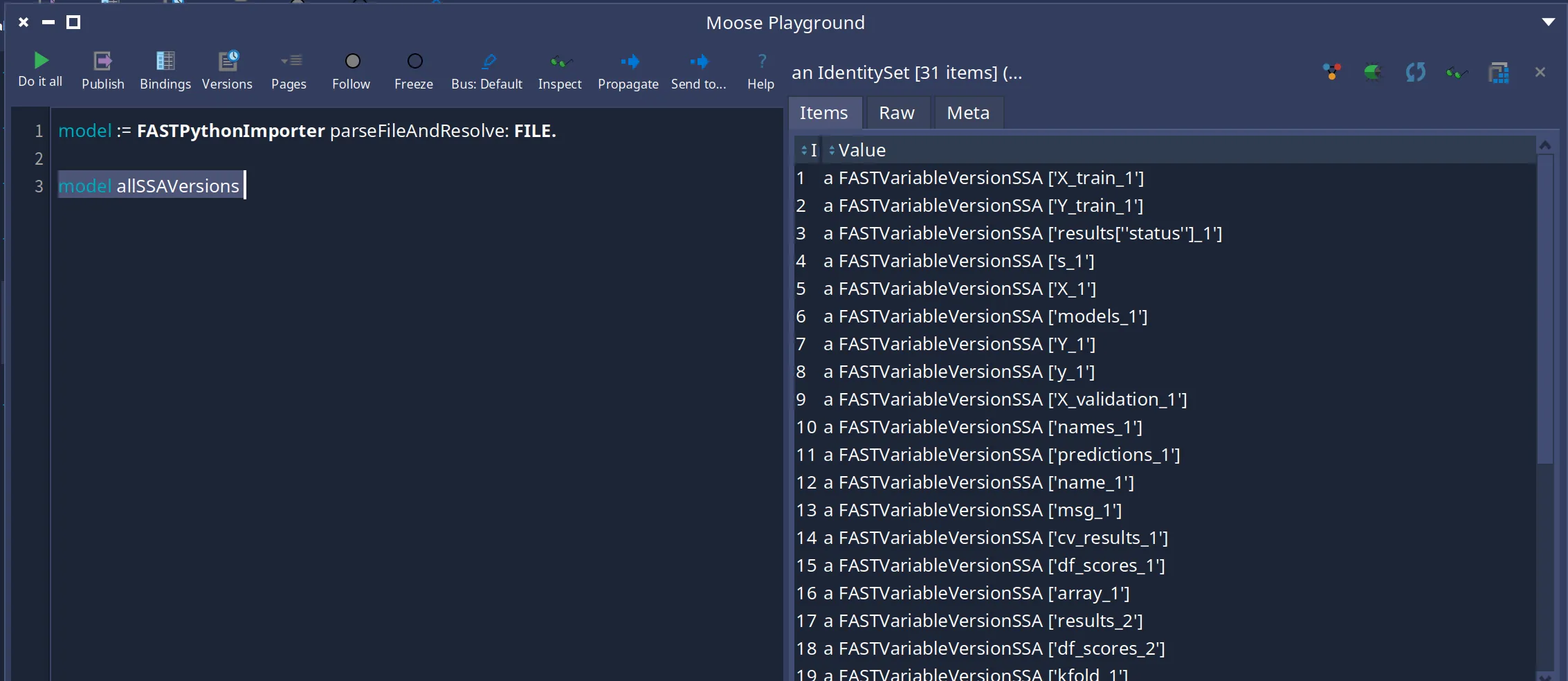
Another possibility is to import and resolve in one step with FASTPythonImporter parseAndResolve: or parseFileAndResolve:.
Once the SSA is done, you can ask:
FASTPyEntity>>#ssaVersionto get the current SSA version of a variable (aFASTVariableVersionSSAor aFASTVariablePhiVersionSSAfor a value that can come from multiple assignments)FASTPyEntity>>#allSSAVersions(and#allSSABasicVersions) to get all the versions a variable can getFASTPyEntity>>#versionReadAccesses/#versionWriteAccessesto get the read/write accesses of the current version of a variableFASTPyEntity>>#transitiveAssignedExpressionsto follow the expressions assigned to a variable and to the variables it uses, recursively
Further reading
Section titled “Further reading”This page gives a compact overview. For the full documentation of the tools and the complete list of the available analysis APIs, see the analysis documentation.